
The panic around AI replacing jobs misses the nuance. McKinsey’s latest research cuts through the noise: while AI will automate many tasks, there are fundamental human skills it cannot replicate—at least not in the foreseeable future.
Here’s what actually matters as we reshape work for the AI era.
The Six Irreplaceable Human Capabilities
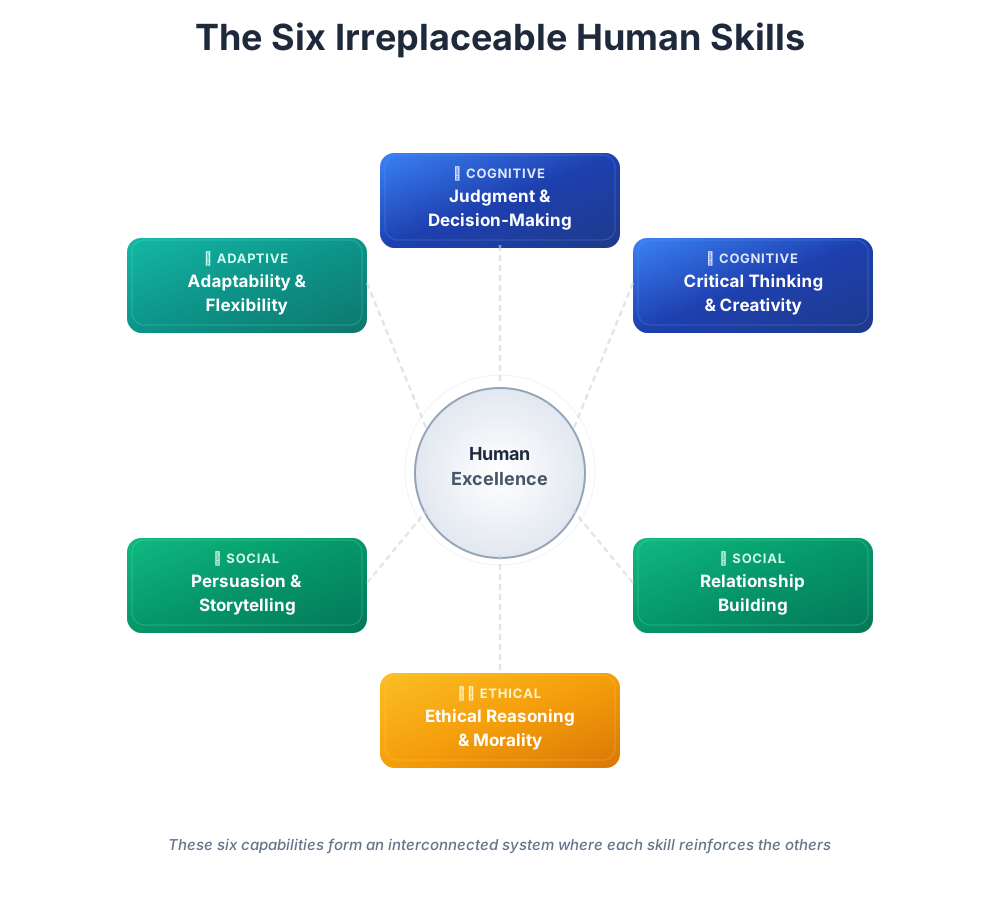
1. Judgment and Decision-Making
AI excels at pattern recognition and data processing. It fails spectacularly at gray-area decisions involving ethics, uncertainty, and competing priorities.
Complex decisions—the kind where you’re weighing trade-offs between engineering quality, business constraints, and team morale—require human judgment. Machines can surface options. They can’t tell you which painful trade-off is the right one for your context.
The ability to consider broader societal impact, navigate conflicting stakeholder needs, and make calls with incomplete information remains uniquely human.
2. Relationship-Building and Social-Emotional Skills
Empathy, trust-building, and conflict resolution aren’t algorithmic problems.
AI cannot truly understand cultural nuance, emotional undercurrents, or the unspoken dynamics in a room. Skills like negotiation, coaching, and managing interpersonal tension require reading what’s not being said—something that demands lived human experience.
As McKinsey notes, these social-emotional capabilities become more valuable, not less, as AI handles routine communication tasks.
3. Critical Thinking and Creativity
AI generates content based on historical patterns. True creativity stems from curiosity, lived experience, and imagination—connecting disparate ideas in novel ways.
Creative problem-solving, designing unprecedented solutions, and complex reasoning that questions assumptions rather than reinforcing them are beyond AI’s current capabilities.
The distinction matters: AI can help you iterate faster on known patterns. It cannot invent fundamentally new approaches or challenge the frame of the problem itself.
4. Ethical Reasoning and Morality
AI follows rules. Ethical dilemmas require values, empathy, and judgment about human consequences.
Understanding the societal impact of technical decisions, applying moral reasoning to ambiguous situations, and choosing the “right” path when there’s no clear answer—these require human wisdom, not computational power.
As AI systems make more decisions that affect people’s lives, the humans designing, deploying, and overseeing these systems need stronger ethical reasoning skills, not weaker ones.
5. Adaptability and Flexibility
Humans intuitively adapt to novel situations, learn from failure, and improvise when established routines break down.
AI struggles with unprecedented scenarios that deviate from training data. The ability to thrive in unpredictable environments, demonstrate resilience under pressure, and pivot when plans fail set people apart.
This matters more as the pace of change accelerates. The teams that win aren’t the ones with the most rigid processes—they’re the ones that can adapt fastest when context shifts.
6. Persuasion, Storytelling, and Influence
Communication is more than information transmission. The ability to inspire, build consensus, and persuade—especially in high-stakes or emotionally charged settings—requires a uniquely human touch.
Storytelling that resonates emotionally, influence that builds genuine buy-in rather than compliance, and leadership that mobilizes people around a vision all depend on human connection.
The Strategic Implication
McKinsey’s bottom line: organizations should invest in building these human capabilities alongside deploying AI tools.
The future isn’t humans or AI. It’s collaborative work where humans focus on judgment, creativity, and relationship-building while AI handles routine, data-intensive, and predictable tasks.
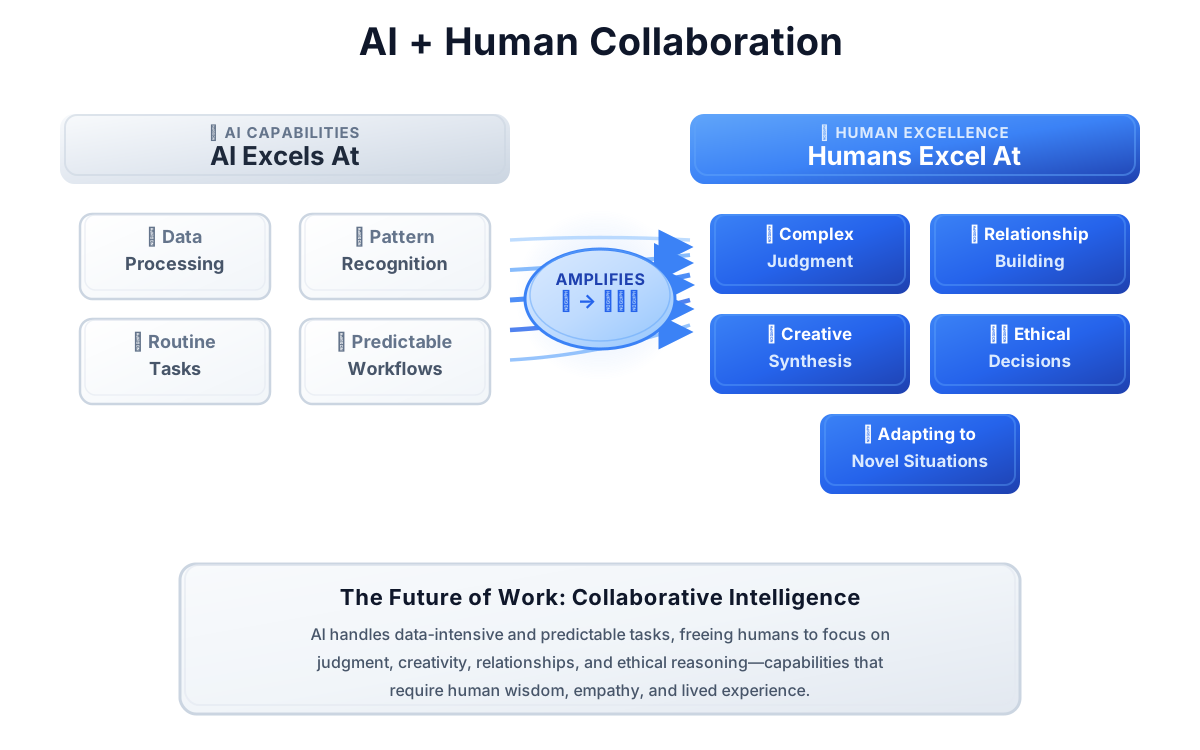
Companies cultivating these human skills—judgment, emotional intelligence, creative thinking, ethical reasoning—will have a distinct competitive advantage in the AI-driven economy.
What This Means for You
If your current role is primarily data processing, pattern matching, or executing well-defined procedures, you’re vulnerable. Not because you’re not valuable—but because those tasks are exactly what AI excels at automating.
If your role requires complex judgment calls, building relationships, navigating ambiguity, or creative synthesis of disparate information, you’re essential. These are the capabilities organizations will pay premium prices for as AI commoditizes everything else.
The engineers that will pull ahead will be the ones that double down on the irreplaceable skills—judgment, creativity, relationship-building—and use AI to amplify their uniquely human capabilities.
What human skills are you investing in? Connect with me on LinkedIn to share your perspective.
This analysis draws on McKinsey’s research on human skills in the age of AI.