
The Model Context Protocol (MCP) team just published “The 2026 MCP Roadmap”: https://blog.modelcontextprotocol.io/posts/2026-mcp-roadmap/
It’s worth reading end-to-end, but here’s the punchline.
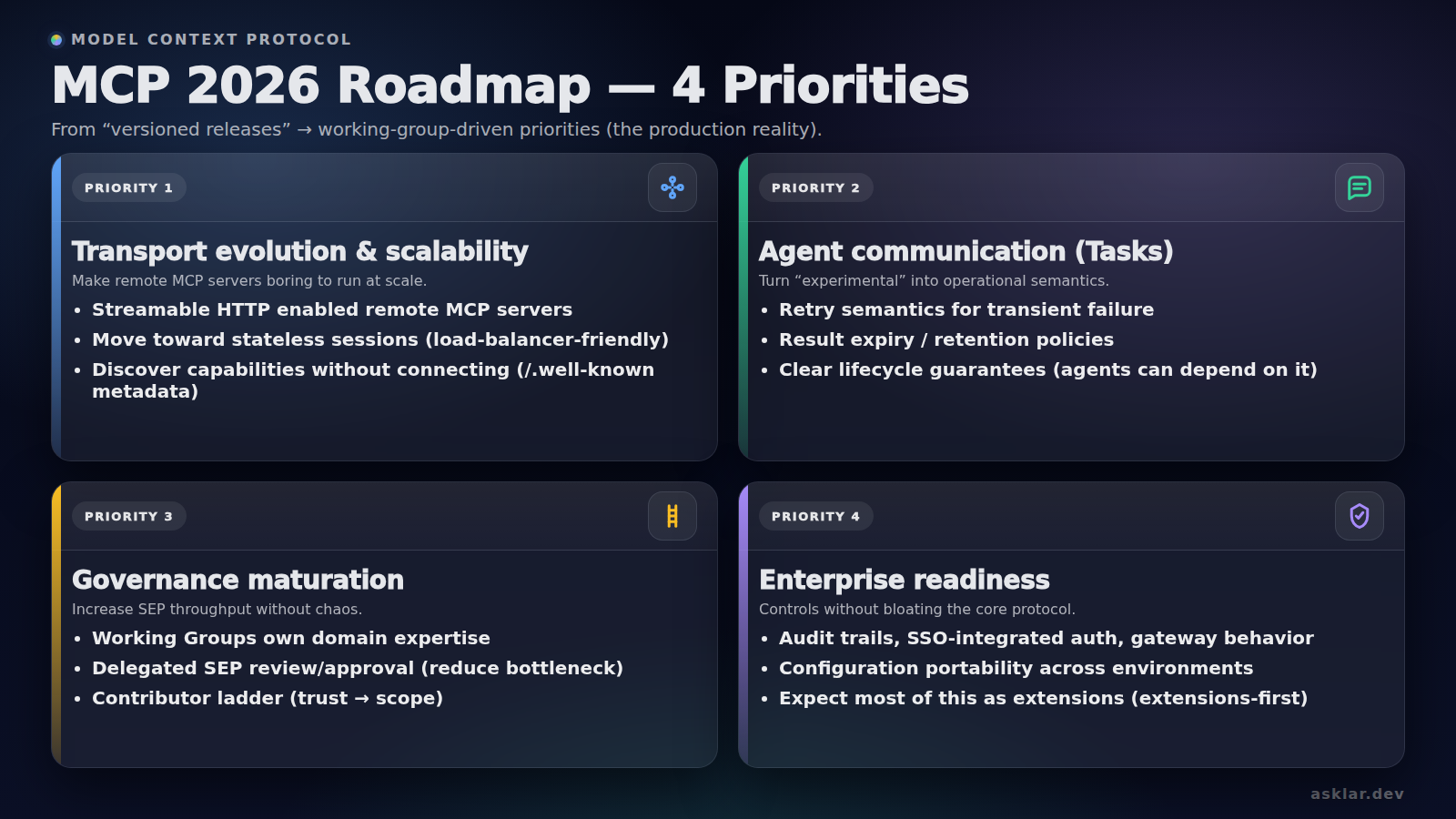
MCP’s roadmap framing has shifted from versioned releases to priority areas driven by Working Groups. That’s a strong signal that MCP is past the “cool demo wiring” phase and is now optimizing for what production users actually hit: scale, governance throughput, and enterprise constraints.
The four priority areas (2026)
1) Transport evolution and scalability
MCP’s Streamable HTTP transport unlocked remote MCP servers. Now real deployments are surfacing the hard problems:
- Stateful sessions vs load balancers
- Horizontal scaling without “sticky sessions” hacks
- Discoverability without connecting (registry/crawlers learning capabilities)
The roadmap calls out two concrete directions:
- Evolve the transport + session model so servers can scale without holding state.
- Add a standard metadata format that can be served via something like
/.well-known/...so clients can discover capabilities without a live connection.
2) Agent communication
The experimental Tasks primitive (SEP-1686) is in the “ship → learn → iterate” loop.
The roadmap mentions lifecycle gaps that show up only under production pressure:
- retry semantics for transient failure
- expiry / retention policies for results
This is exactly the kind of work that turns a protocol from “possible” into “operationally boring”.
3) Governance maturation
As MCP adoption rises, governance becomes a scaling bottleneck.
The core issue: every SEP currently requires full core maintainer review, even for domain-specific topics where a Working Group has the expertise.
The roadmap points at:
- a documented contributor ladder
- a delegation model where trusted Working Groups can accept SEPs in their domain
That’s the only sustainable way to keep pace without collapsing into chaos.
4) Enterprise readiness
This is the most interesting (and intentionally least-defined) bucket.
Enterprises deploying MCP are asking for:
- audit trails
- SSO-integrated auth
- gateway behavior
- configuration portability
Two details matter here:
- There isn’t a dedicated Enterprise WG yet; the maintainers are explicitly asking enterprise folks to help define it.
- The maintainers expect most enterprise work to land as extensions, not core protocol changes, so MCP doesn’t become heavyweight for everyone.
What this means if you’re building on MCP
If you’re a contributor
The roadmap now includes explicit guidance on SEP prioritization:
- SEPs aligned with the priority areas should move faster.
- Outside the priority areas, expect longer timelines and a higher bar.
If you want something to land, the best path is to bring it to the right Working Group and make the mapping to the roadmap explicit.
If you’re deploying MCP in production
The protocol’s center of gravity is shifting toward:
- operational scalability (session model + transport)
- discoverability (metadata without connecting)
- enterprise controls without bloating the base spec
In other words: fewer “new shiny transports,” more “make the boring stuff correct.”
On the horizon
The roadmap also calls out work that didn’t make the top four but still has real community interest, including:
- triggers and event-driven updates
- streamed / reference-based result types
- deeper security and authorization work
- maturing the extensions ecosystem
Closing thought
The meta-signal here is healthy: MCP is being treated like an open standard that needs process, not just features.
If you’re betting on MCP long-term, this roadmap is the first one that really reads like it was written by people who’ve run protocols at scale.
If this was useful, connect with me on LinkedIn (I post more notes like this + practical agent tooling): https://www.linkedin.com/in/asklar/
Source: The 2026 MCP Roadmap — https://blog.modelcontextprotocol.io/posts/2026-mcp-roadmap/