
A “moat” is what protects your business from competition—the reason customers can’t easily switch to a competitor or why new entrants struggle to replicate what you do. Traditional moats include brand loyalty, network effects, economies of scale, or simply the difficulty of execution.
Traditional entrepreneurial advice follows a simple pattern: find a painful problem, build a solution, and execution difficulty becomes your moat. This assumption has held for decades.
It’s breaking down. When AI agents automate implementation, the barrier to entry evaporates. This is structural economic analysis: what happens to business models when their primary defense becomes commoditized?
The threat comes from two fronts:
- Competitors using AI to level the playing field — Your execution advantage disappears when anyone can build what you built
- AI agents themselves cannibalizing traditional industries — The software doesn’t just make humans faster; it replaces entire value chains
Both forces accelerate commoditization, but they create different dynamics. The first drives margin compression. The second questions whether the business exists at all.
The Execution Moat Collapse
A solo developer with Claude can build in days what previously required a team and weeks. The execution barrier dropped from “hire a team” to “write clear specifications.”
This pattern extends across domains:
- Tax preparation: AI packages expertise into prompts and validation rules
- Bookkeeping: AI judgment becomes inference patterns
- Legal document review: AI combines retrieval + reasoning
When execution commoditizes, traditional time-based moats fail:
- First-mover advantage: Competitors don’t need months to build—they need hours to specify
- Network effects: If an agent can build your product, it can build alternatives too
- Brand recognition: Products converge toward “what AI does well”
The uncomfortable implication: Speed to market matters less when the market can replicate you faster than you can iterate.
What Moats Survive? An Economic Framework
From an economics perspective, defensible moats fall into several categories—only some survive AI commoditization:
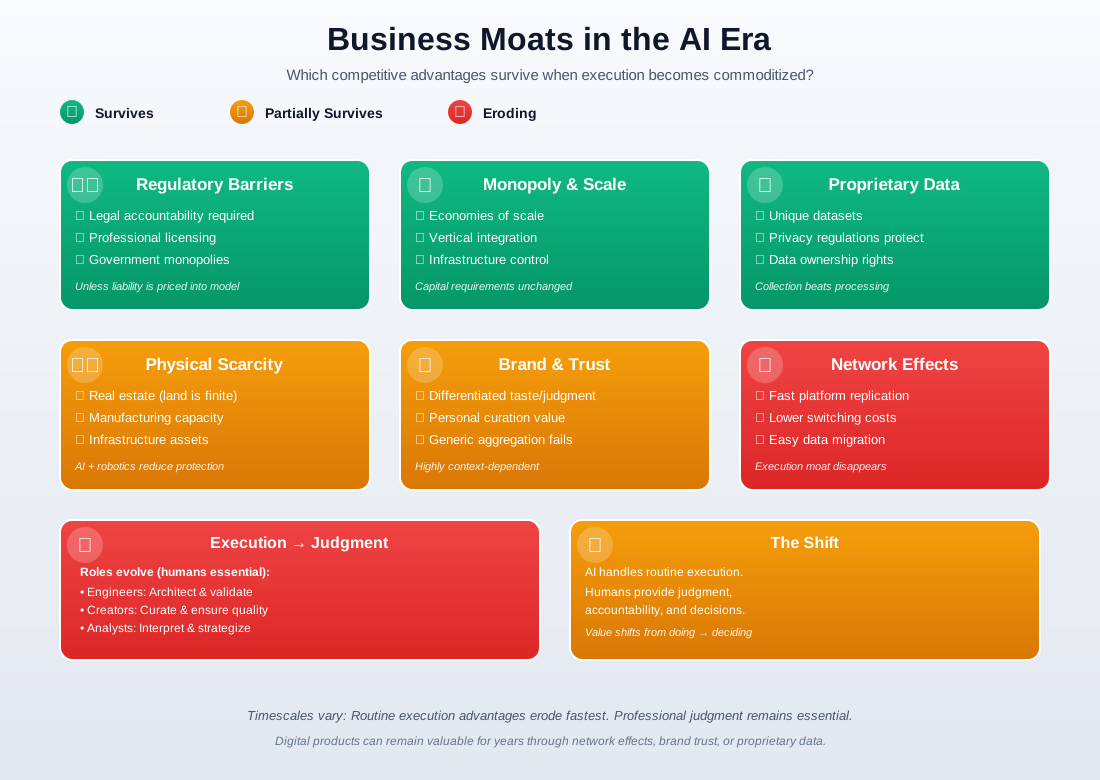
1. Regulatory Barriers (Survives)
Legal accountability: Professions where humans must sign and accept liability—doctors, lawyers, CPAs, licensed engineers. AI can do the work, but someone must validate and guarantee it. The liability requirement creates a bottleneck.
Government-granted monopolies: Broadcast licenses, taxi medallions, liquor licenses. These create artificial scarcity independent of execution capability.
The nuance: This protection only holds if liability risk isn’t priced into the business model. Companies willing to accept AI liability (via insurance) can eliminate this barrier—which is exactly the AI + Insurance opportunity explored later.
2. Physical Scarcity (Partially Survives)
Natural constraints: Real estate (finite land), resource extraction (minerals, energy), infrastructure (power grids, transportation).
The challenge: AI + robotics changes this equation. Automated manufacturing, robotic construction, and AI-optimized logistics reduce the protection physical scarcity provides. AI can’t create more land, but it can dramatically reduce the labor and expertise needed to develop it. The moat shrinks but doesn’t disappear.
3. Network Effects (Eroding)
Traditional network effects: Value increases with users (social networks, marketplaces, payment systems).
Why it erodes: When AI can build competing platforms quickly, initial network advantages matter less. The execution moat that protected early network growth disappears. Switching costs drop when agents can migrate your data and recreate integrations.
4. Proprietary Data (Survives, Transforms)
Data moats: Unique datasets that improve AI performance—medical records, transaction histories, user behavior patterns.
The shift: Data collection becomes the moat, not data processing. Anyone can build the AI; not everyone can access the training data. Privacy regulations and data ownership create barriers.
5. Brand & Trust (Context-Dependent)
Differentiated taste: When your specific judgment is the product (e.g., David Pogue’s tech recommendations), brand survives.
Generic aggregation: When you’re just filtering by popularity signals, AI replicates you. Most “curators” fall into this category.
6. Monopoly & Market Power (Survives)
Economies of scale: Some businesses have cost structures that favor dominance—cloud infrastructure, chip manufacturing, logistics networks. AI doesn’t change the capital requirements or operational complexity.
Vertical integration: Control of supply chains and distribution channels. AI can optimize but can’t replicate ownership.
What Doesn’t Survive: Pure Execution Excellence
The shift: AI handles routine execution, but humans remain essential for judgment, validation, and accountability.
Software development, content creation, data analysis, administrative work—the routine execution aspects become commoditized. But this doesn’t eliminate the need for skilled professionals. Instead, roles evolve:
- Software engineers shift from writing boilerplate to architecting systems, making design decisions, and validating AI-generated code
- Content creators move from drafting to curating, editing, and ensuring brand voice and quality
- Analysts transition from data processing to interpretation, strategy, and communicating insights
- Professionals become validators and quality controllers rather than pure executors
The key distinction: “Good enough at 5% cost” applies to commoditized execution tasks, not to the judgment, creativity, and accountability that define professional work. We still need humans who know better—the value just shifts from doing to deciding, validating, and guaranteeing.
The AI + Insurance Business Model
Here’s the counterintuitive opportunity: Don’t sell AI as software. Sell it as insured professional services.
Why Software Moats Fail
Build an AI tax tool for $50/year: competitors replicate it, customers choose on price, and liability stays with the user. No defensible moat.
The Insurance Alternative
Sell tax preparation as a service with E&O coverage:
- AI prepares the return
- Human CPA validates edge cases
- Company signs as preparer with E&O insurance
- Customer pays $200/year for guarantee
Value shifts from “our AI is better” to “we’ll pay you if we’re wrong.”
Why this creates a moat:
-
Underwriting expertise - Price AI risk correctly or lose money. Requires historical error data and domain knowledge. Software companies lack this; insurance companies don’t understand AI risk.
-
Regulatory compliance - Insurance licenses, reserve requirements, legal review. Administratively expensive and slow—a genuine barrier.
-
Risk pooling economics - 1,000 customers = high variance. 1,000,000 customers = predictable. Early entrants have structural cost advantages.
-
Liability acceptance - Big tech may not do it (catastrophic payout risk at scale). Traditional practitioners can’t (don’t understand AI risk, can’t achieve scale). The gap is real.
Real-world precedent: TurboTax already offers audit defense and accuracy guarantees—they’re pricing liability into the business model. But they stop short of full E&O coverage. The opportunity is broader: bookkeeping with fraud insurance, engineering calculations with professional liability, medical diagnostics with malpractice coverage.
The Economics
| Approach | Cost | Quality | Risk |
|---|---|---|---|
| Human-only | $500 | High | Low (expert accountability) |
| Software-only | $50 | Medium | High (customer absorbs errors) |
| AI + Insurance | $200 | High | Low (vendor absorbs errors) |
The sweet spot: better protection than software-only, cheaper than human-only, similar risk profile to expert work.
The Transition Period: What Changes
For Knowledge Workers
Traditional advice: Build expertise, become indispensable, command premium rates.
New reality: Your expertise gets captured in prompts and training data. The premium shrinks as AI replicates your patterns.
Rational response: Maximize earnings now while skills command premium rates, invest in assets that don’t commoditize (real estate, equity), develop validation skills (judgment, quality control, risk assessment).
If your skill set has a 10-year half-life, the financially optimal strategy isn’t to resist AI—it’s to arbitrage the transition period.
For Entrepreneurs
Old playbook: Find painful problem → Build solution → Execution difficulty is moat → Grow before competitors catch up
What breaks: Steps 3 and 4. Execution is no longer the moat. Competitors catch up in hours, not months.
New questions:
- What can I control that AI cannot? (Physical assets, regulatory licenses, unique data, specialized relationships)
- Where does legal accountability create a barrier? (Professions requiring signatures and liability acceptance)
- Can I sell insurance on AI work? (Be the entity guaranteeing AI outputs)
- Can I profit from the transition itself? (Infrastructure, compliance, validation services)
Most entrepreneurial advice assumes execution difficulty. That assumption is obsolete.
What Survives
Defensible moats shift from execution to:
- Regulatory barriers - Licensing, insurance requirements, liability acceptance
- Physical constraints - Land scarcity, capital-intensive infrastructure (though AI + robotics erode this)
- Proprietary data - Unique datasets that improve AI performance
- Monopoly & scale - Network effects, vertical integration, economies of scale that survive execution commoditization
- Differentiated judgment - Taste and curation where your specific perspective is the product
- Risk-taking - Financial guarantees on AI work via insurance
Avoid building where (at least for long-term defensibility):
- Primary value is “we execute well” (AI will replicate this)
- Product is purely digital with no accountability layer
- Differentiation comes from features, not structural advantages
Note: These vulnerabilities play out over different timescales. Pure execution advantages erode fastest. Some digital products remain valuable for years through network effects, brand trust, or proprietary data—but eventually face commoditization pressure as AI capabilities advance.
The Uncomfortable Conclusion
Traditional entrepreneurial advice assumes execution difficulty creates the moat. That assumption is obsolete.
What survives: work with legal accountability humans cannot delegate, businesses built on physical or regulatory scarcity, services that sell guarantees rather than capabilities, and monopolies where scale creates structural advantages.
The transition is accelerating. Old playbooks fail. New ones are emerging around insurance, validation, and risk acceptance—not just better execution.
The question isn’t whether this happens. It’s whether we adapt fast enough to build businesses that survive it.
What business models do you think survive the AI transition? Connect with me on LinkedIn to discuss where the defensible moats are moving.